

 01270 360035





Computing
Intent
The National Curriculum states that a high-quality computing education enables pupils to use computational thinking and creativity to understand and change the world, with the core focus on computer science, information technology and digital literacy. Our curriculum is designed to reflect these aims by ensuring that pupils:
- Understand and apply key principles of computer science, including algorithms, logic and data representation
- Develop the ability to analyse problems and design programs
- Use information technology to create, organise and present content
- Become responsible, confident and creative digital citizens.
Through Kapow, we aim to foster a love of computing and a confidence to “tinker” with technology, developing pupils who are both digitally competent and adaptable in a rapidly changing technological landscape.
Our curriculum is designed to be:
- Ambitious and inclusive, ensuring all pupils can access learning
- Carefully sequenced, allowing knowledge to build progressively
- Relevant and purposeful, linking computing to real-world context.
Implementation
The Computing curriculum is implemented through the Kapow Primary scheme, which provides a structured and progressive framework aligned to the National Curriculum.
Kapow is organised around the three core strands of the National Curriculum:
- Computer Science
- Information Technology
- Digital Literacy
These are delivered through five key areas that are revisited across the school:
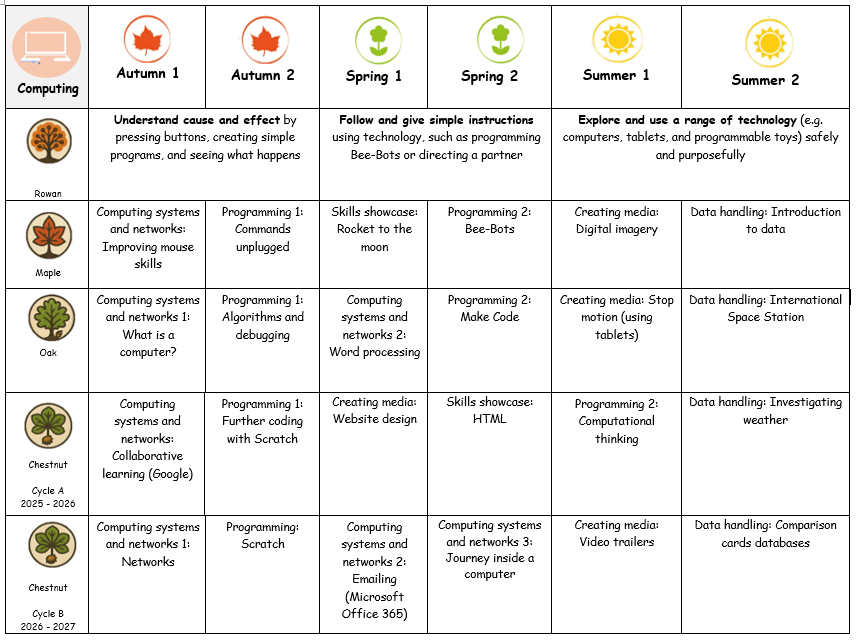
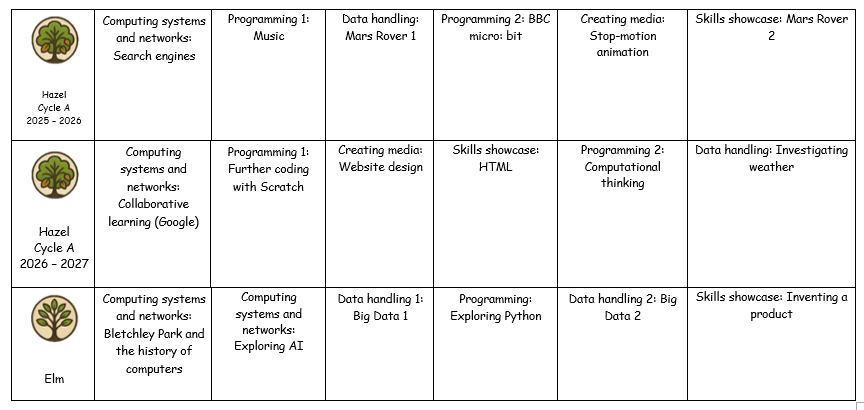
- Computing systems and networks
- Programming
- Creating media
- Data handling
- Online safety
This structure creates a spiral curriculum, where pupils revisit concepts and develop them with increasing complexity, ensuring knowledge is embedded and retained over time.
-
Computing is taught regularly, using a combination of unplugged and digital activities to build understanding
-
Lessons incorporate modelling, independent work, paired and collaborative tasks, ensuring engagement for all learners.
-
Explicit vocabulary teaching supports pupils in articulating their understanding
-
Knowledge organisers are used to support retrieval and retention
Online safety is embedded as a key thread throughout the curriculum, ensuring pupils understand how to:
- Use technology safely and responsibly
- Recognise risks and seek help
- Develop positive online behaviours
This aligns with the National Curriculum expectation that pupils use technology safely, respectfully and responsibly.
In our mixed-age setting:
- The Kapow curriculum is carefully mapped to ensure full National Curriculum coverage for each year group by the end of Key Stage 2
- Learning is adapted so that pupils work at an appropriate level of challenge within shared topics
- Knowledge is revisited and deepened, ensuring progression rather than repetition
Kapow provides meaningful opportunities to link computing with other subjects such as science, art and music, supporting the application of transferable skills across the curriculum.
Impact
As a result of our Computing curriculum, pupils at Little Leigh Primary School:
-
Develop secure and progressive knowledge across all areas of the National Curriculum
-
Demonstrate the ability to think computationally and solve problems
-
Use technology creatively and purposefully across a range of contexts
-
Show confidence and independence when encountering new technology
-
Understand how to stay safe and behave responsibly online
Pupils leave Little Leigh as:
-
Digitally literate individuals, able to express ideas through technology
-
Critical thinkers, able to evaluate and apply digital tools effectively
-
Responsible and informed users of technology, prepared for the next stage of education
Evidence of impact is seen through:
-
Pupils’ work showing progression in knowledge, skills and vocabulary over time
-
Discussion and pupil voice, demonstrating confidence and understanding
-
Application of computing skills across the wider curriculum
For further information, contact Jo Proctor jproctor@littleleighprimary.cheshire.sch.uk
Files to Download